
Déjate seducir por el mundo del vino
Déjate seducir por el mundo del vino
7 octubre, 2025
Colin Harkness
We finally met Francisco, universally known as, Curro, the visionary owner of Coster d’En Sala, after a couple of enforced postponements – and I’m so pleased we did! Our first date was cancelled because of an Orange Weather Alert, likely to turn Red. If the predicted very heavy rainfall was serious enough to close local schools, then it was clear that a walk in the vineyards was going to turn into a yomp.
Hastily rearranged, we had to postpone once again, this time for a medical appointment and whilst I’m a believer in the medicinal properties of wine (up to a point!) we had to withdraw once more. However, late afternoon recently on a typically beautiful day in the countryside approaching Javea we arrived at the vineyards that, at present, are the only physical presence of Coster d’En Sala. It’s a work in progress and, judging by the wine we tasted, and more, it’s certainly a promising one, as it’s already delivering!
One of the team, Antonio, set up a trestle table with four folding chairs underneath delightful olive trees where we sat, surrounded by vineyards, now devoid of their grapes with only the leaves remaining, and those not for long either. All very lovely, but I was itching to find out about the varieties as I’d heard that, for this area, they were perhaps a little unexpected. Curro made me wait!
Coster D’en Sala consists of 22 hectares (about 50 acres) of mostly flat land which had been secured at one time for the extension of Javea Golf Club. However, the club was able to convert their course to 18 holes anyway and then ‘La Crisis’ hit home. The land was left to nature and became, as Curro frankly said, ‘a bit of a mess’.
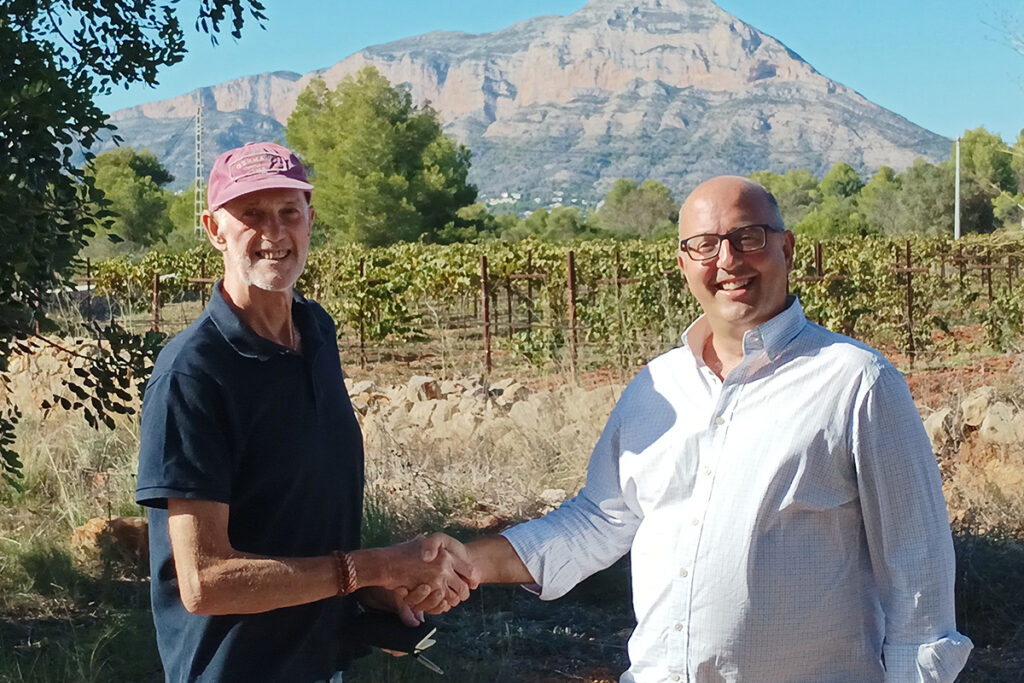
Curro has a history of Agri-business, agricultural business. He was the CEO of companies that dealt with wine, ham and rice in various different parts of Spain, though not in his native Zaragoza. He and his family were thinking of a new project, a finca somewhere beautiful with land to maybe grow vines. They came across the land in which they have now invested and realised that this was it – yes, it needed work and effort, but when you have a dream it’s worth it.
Whilst Curro has experience of the wine world, he is the first to admit that he’s not a winemaker. Enter Óscar Mestre. 5Barricas followers will know of this young man making very high quality wines in a defined area of the family winery in Jalón, Bodegas Riko, but under his own name. Óscar Mestre wines are gaining plaudits both nationally and internationally and have figured here (https://5barricas.valenciaplaza.com/oscar-mestre-wines-jalon/).
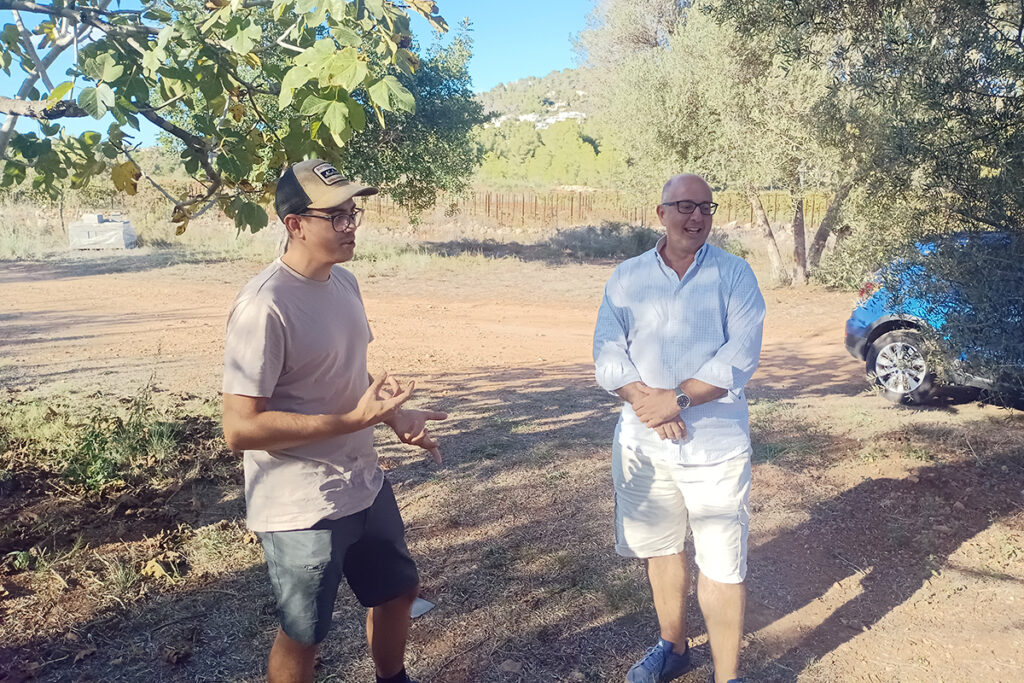
We had wondered for whom the other chair was destined – a big, well used four-wheel drive vehicle drew up soon after we’d sat down. My wife, Claire-Marie, (https://www.youtube.com/watch?v=mAYQFB_bpl8&list=RDmAYQFB_bpl8&start_radio=1),
who used to teach Óscar French several years ago, and I recognised the car – and of course, its driver.
I was already invested in Curro’s wines following an exchange of e-mails etc prior to our meeting, and when I learned that Óscar Mestre had been appointed as Head Wine Maker I knew I’d been right to be so! It became clear as we chatted (now with a glass of Curro’s first ever wine) that Óscar sees Coster d’En Sala as a very promising project and he’s delighted to be involved (though where he finds the time?). The two dovetail together perfectly – business-wise Curro takes the lead; winemaking-wise it’s Óscar at the head; wine-style wise, it’s a close collaboration. Bottom line, judging by the first ever Coster d’En Sala wines, the 2024 vintage – it works!
Perhaps the key to bringing Óscar onboard was Curro’s dislike of Moscatel (yes, I know – in this area it’s almost like an Italian saying he doesn’t like pasta!) and his belief that another Mediterranean variety can easily fill the void if darling of the area, Moscatel, is not to be used. It’s an interesting concept, going, as it does, against the grain of current, applaudable local support for using indigenous varieties. Moscatel has been grown in this area of Marina Alta for centuries and is fully adapted to the local terroir, grown as it is in the bush/goblet shape that is seen all over here.
But, Curro says, what if we choose another white wine variety, also Mediterranean and not necessarily grown at altitude (Coster d’En Sala is just under 50 metres above sea level)? A variety whose looser bunches can take advantage of the particular micro-climate of the land he owns (7.1 hectares of which are devoted to vines) and in particular of the Llebeig (I think?!) wind that blows across the vineyard between 10:00 am – 8:00 pm, producing a greater diversity of temperatures and, because of the ease of airflow, making the grapes more resistant to disease.
Plus, what about using a system completely different from the goblet shape of the vines – i.e. using, quelle horreur, trellising. In fact, let’s go further, let’s use different shapes of trellising. Curro is convinced that having a variety of different shapes of trellising according to the differing aspects of each parcella will make a beneficial difference to the health of the plants and, of course, to the resulting wines!
Yes, Curro, all very interesting, innovative in fact – but hey, can you now tell us which varieties you are using, please?
The chosen champion variety for the white, Terra Xabeae 2024 Blanco is Pansa Blanca (aka Xarel-lo), with back up from another Mediterranean variety, though originally from way up and along the coast into the northern Med., Malvasía. For the red, well this time it is very local, though again it could be argued that, originally Giró was actually Grenache, whose DNA changed dramatically over the centuries, influenced also by where it was grown.
Pansa Blanca/Xarel.lo is, of course, one of the three principle grape varieties employed in the elaboration of Spain’s great Traditional Method sparkling wine, Cava. It’s Mediterranean alright, but further north in Spain, mostly in Cataluña, where enterprising young winemakers, in DO Penedés, for example, have been very successfully using it to make excellent still wines.
I’ve described Malvasía before as that variety which is always the bridesmaid, rather than the bride, as it’s often in the blend, adding considerably to the final product, but sometimes not even mentioned. Well it makes its presence felt here, for sure.
Terra Xabeae Blanco is a modern Spanish white wine – there’s fruit yes, but it’s not in your face, and that’s deliberate. The Coster D’en Sala team is looking for a fresh, subtle wine, with umami notes, a little salinity, a touch of minerality. A wine that speaks of its origins allowing the grapes to express themselves. It’s a bright thirst-quenching wine, with a touch of green melon fruit and perhaps a little apricot.
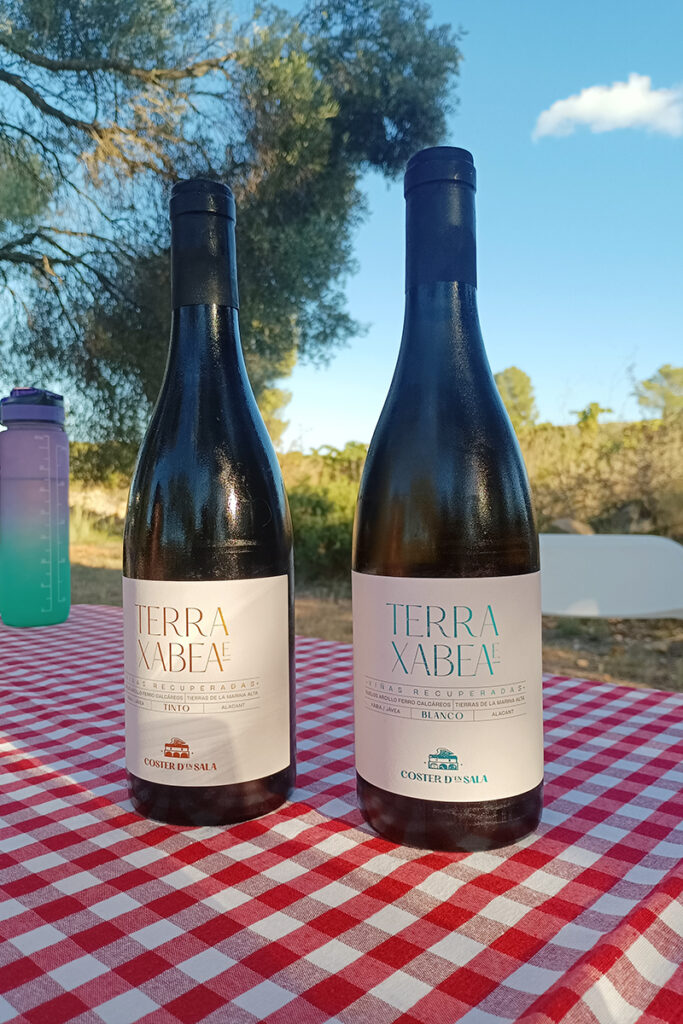
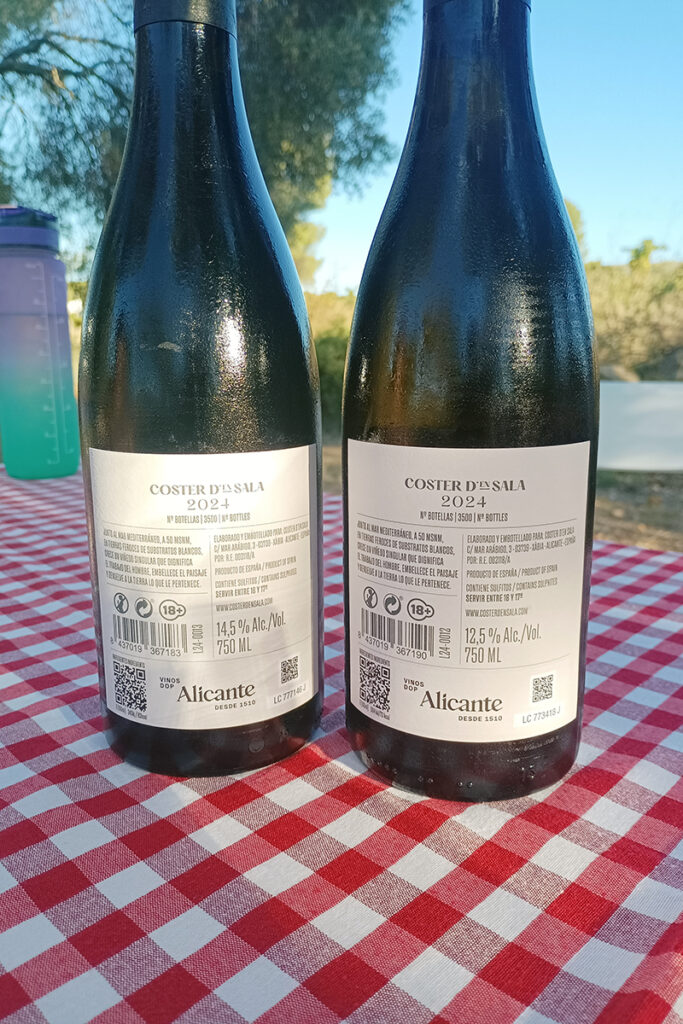
Terra Xabeae Tinto 2024 uses, this time the very local, Giró along with, what they are impishly calling ‘Petit Giró’ which is a pseudonym for another variety (more on this soon!) As with the white this red wine is made using indigenous yeast meaning, once again, that it is a wine that tells of its place. A small percentage of the almost finished wine has had 6 months in large French oak foudres, adding some body and mouthfeel.
There’s a quite peppery note to the wine when held on the palate with a touch of black olive too. In the glass it’s darker in colour than a monovarietal Giró and dark fruits come out on the nose when the wine is swirled and sniffed, think black cherry and fresh hedgerow blackberries.
The white and red wine varieties were planted in 2020, showing what can be done with a young vine. As we looked around the vineyards, from our seats and also, later, from the car as we observed different parcellas we could see no ground covering plants between the rows. Again, this is a little revolutionary as the current thought is that green grass and herbs between the rows help the vines in a number of ways. However, whilst this is true it’s also correct to say that this vegetation is taking the nutrients that newly planted vines need more to establish themselves. And this is a long-term project – Curro’s youngest daughter, who’s impressive tree house looks out across the vineyards (she’s only seven!) may be the one who becomes the second generation of this new bodega in Spain.
Chatting with both Curro and Óscar it became apparent that this is a winery that will be subject to change over the years. They’re not like a current Premier League Manager who refuses to alter, to tweak his beliefs (which as a Liverpool supporter and ex-employee, absolutely delights me!). These guys will make any changes deemed necessary to eventually, as Curro says, enable them to make a Grand Cru/Premier Cru wine – here, in Javea. Indeed, Óscar tells me that we can expect the 2025 vintage, currently finishing in the bodega, to be quite different from the 2024.
Bring it on, I say!
Readers can find out more, including wine tourism information here:
NB Coster D’en Sala wine can be found at:
Vinos y Delicias/La Trastienda, Javea Pueblo
El Celler de la Fontana, Javea Puerto y el Arenal
Bodega Miguel, Javea Pueblo
Bodega Sortetes, Javea Pueblo
Oli de Gorgos, Gata de Gorgos
Se advierte al usuario del uso de cookies propias y de terceros de personalización y de análisis al navegar por esta página web para mejorar nuestros servicios y recopilar información estrictamente estadística de la navegación en nuestro sitio web.
0 comentarios en